After Hurricane Isaias: Clearing Storm-Downed Trees and Stumps on the Emerald Coast

What Isaias did to our trees
Hurricane Isaias made landfall near Destin on the night of October 9, 2026, as a Category 2 storm, the season’s first Atlantic hurricane. The National Weather Service office in Mobile reported widespread damage around Okaloosa County, concentrated in the southern and western parts of the county, with significant tree damage including hardwoods. Walton County lost power to roughly 85% of customers, Okaloosa to about 53%, and neighbors from Miramar Beach to Panama City Beach spent the following days clearing limbs and fallen trees.
Six weeks later, many yards still have the same leftovers: trunks cut into rounds, piles of brush, and the stumps or upturned root balls the trees left behind. This guide walks through the order we recommend for tackling them.
Safety first
- Stay away from power lines. Treat every downed line as live. If a tree or limb is touching a line, call your electric provider; UF/IFAS advises that limbs near power lines be handled by a qualified line-clearance arborist.
- Trees on houses, cars or fences need a professional tree service. Wood under tension can spring back with enough force to cause serious injury.
- Hanging and cracked limbs come down first. UF/IFAS’s guide to restoring trees after a hurricane says to remove hanging and detached limbs before other work so they can’t fall on anyone.
- Don’t rush to remove trees that are still standing. A pine that survived may have hidden damage; UF/IFAS suggests waiting to see whether it lives before deciding to restore or remove it, and having a certified arborist assess trees you’re unsure about.
Stump grinding comes at the end of this process, after the tree is down and the trunk has been cut and hauled. That’s where we come in.
Debris at the curb
Most storm debris pickups along the coast use the same basic rules. When Fort Walton Beach started its Isaias cleanup, the city asked residents to keep vegetative debris (trees, limbs, branches) separate from construction debris such as fences, docks and building materials, and to place debris loose at the curb because bagged debris wouldn’t be collected. FEMA’s guidance after Hurricane Michael was similar: follow local officials’ instructions and sort debris into separate piles.
- Pile debris at the curb or edge of the right-of-way, not in the road, and keep it clear of mailboxes, fire hydrants, water meters and storm drains.
- Rules on whether stumps and root balls are collected, and how big a piece can be, vary by city and county and change from storm to storm. Check the latest instructions from Okaloosa, Walton or Bay County, or your city, before you stack them.
- Pickup crews generally take what’s at the curb, not what’s still in the ground. A stump or root ball that’s still rooted in your yard is yours to deal with.
Stumps and root balls
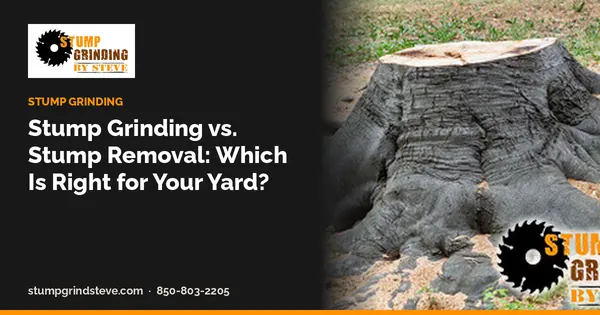
When a tree blows over, it often lifts a plate of roots and sandy soil with it, leaving a crater on one side and a wall of roots on the other. After the trunk is cut free, that root ball can settle back toward the hole or stay propped up. Either way it’s a trip hazard and a mowing headache, and it keeps you from regrading the yard.
A stump grinder chips the stump or root ball down below ground level, right where it sits. There’s no need to drag a heavy root ball across your lawn or dig out a hole twice its size. Afterward you’re left with a pile of chips and soil that can be raked back into the hole or used as mulch. Our larger grinder is built for exactly this kind of job; it’s how Steve & Sue started, grinding root balls left by Hurricane Michael.
A few tips while you wait for your grinding appointment:
- Have the trunk cut as close to the ground as safely possible, but leave the root ball itself in place.
- Flag the spot so nobody mows or drives into it.
- Note any sprinkler heads, landscape lighting or invisible pet fences nearby so we can avoid them.
- Take photos for your insurance claim before the tree and stump are cleaned up.
Call 811 before grinding
Florida’s Underground Facility Damage Prevention and Safety Act (Chapter 556, Florida Statutes) requires anyone digging or disturbing the ground to contact Sunshine 811 at least two full business days before the work so underground utilities can be marked. Calling is free, either by dialing 811 or at sunshine811.com.
There is a narrow exemption for owners of single-family homes doing their own digging, but only up to a depth of 10 inches, on their own land, and away from any utility easement. Stump grinding often goes deeper than that, and it’s done by a contractor rather than the owner. That’s why we have lines located before we grind. Once the lines are marked, Florida law says not to dig with power equipment within 24 inches of the marks.
Look for termites
UF/IFAS entomologist Thomas Chouvenc notes that many trees that fall in storms would have survived if termites hadn’t hollowed them out first. If a fallen trunk or stump is hollow or full of mud tubes and galleries, that’s worth paying attention to, especially near your house. UF/IFAS keeps a termite distribution map that shows where the main invasive termite species have been found in Florida; if you’re worried, have a licensed pest control company take a look at the house.
Replant for the next storm
UF/IFAS studied tree survival after the hurricanes that struck the Florida Panhandle, including Erin, Opal, Ivan and Dennis. In Hurricane Ivan’s 130 mph winds, the species with the highest survival included sand live oak, American holly, southern magnolia, live oak, wax myrtle, sweetgum, crape myrtle, dogwood and sabal palm. Laurel oak survived significantly worse than live oak and sand live oak, and sand pine showed poor wind resistance.
| Stood up well in Panhandle hurricanes | Fared worse |
|---|---|
| Live oak, sand live oak, southern magnolia, American holly, sabal palm, crape myrtle, dogwood, wax myrtle | Laurel oak, water oak, sand pine |
If you plan to plant a new tree near where a stump was ground, see What to Do After Stump Grinding for how to prepare the spot.
Frequently asked questions
Will the county pick up my stump after Hurricane Isaias?
It depends on where you live and the current rules for that storm. Some cleanups accept stumps and root balls that have been placed at the curb with other vegetative debris; crews generally don’t remove stumps still rooted in your yard. Check the latest instructions from your city or county.
Do I need to call 811 before stump grinding?
Yes. Florida law requires contacting Sunshine 811 at least two full business days before digging. The homeowner exemption only covers digging up to 10 inches deep on your own single-family property, and stump grinding often goes deeper than that.
Can you grind a root ball that’s still standing up?
Usually, yes. Once the trunk has been cut off, we grind the root ball down in place so the ground can be leveled. Call or text photos to 850-803-2205 and we’ll let you know what it will take.
What trees should I plant to replace the ones I lost?
UF/IFAS research on Panhandle hurricanes found live oak, sand live oak, southern magnolia, American holly and sabal palm among the most wind-resistant choices. Laurel oak, water oak and sand pine fared worse.
Sources
- FOX Weather: Hurricane Isaias from start to finish (opens in a new tab)
- National Weather Service Mobile/Pensacola: Hurricane Isaias (2026) county impacts (opens in a new tab)
- WLRN: Deaths reported in Florida after Hurricane Isaias moves through Panhandle (Oct 10, 2026) (opens in a new tab)
- WJHG/FOX10: Fort Walton Beach to begin Hurricane Isaias debris cleanup (opens in a new tab)
- FEMA: Hurricane Michael debris removal guidance (opens in a new tab)
- UF/IFAS: Restoring Trees After a Hurricane (ENH-1054) (opens in a new tab)
- UF/IFAS Gardening Solutions: Deciding When to Remove Trees (opens in a new tab)
- Sunshine 811: About Sunshine 811 (opens in a new tab)
- Florida Statutes § 556.108: Exemptions (opens in a new tab)
- UF/IFAS: Fallen trees can reveal hidden termites (2024) (opens in a new tab)
- UF/IFAS: Selecting Coastal Plain Species for Wind Resistance (FOR119) (opens in a new tab)
This article is general information, not legal or professional advice. Rules for storm debris pickup and utility locates can change; check with your city or county and Sunshine 811. Last reviewed November 21, 2026.